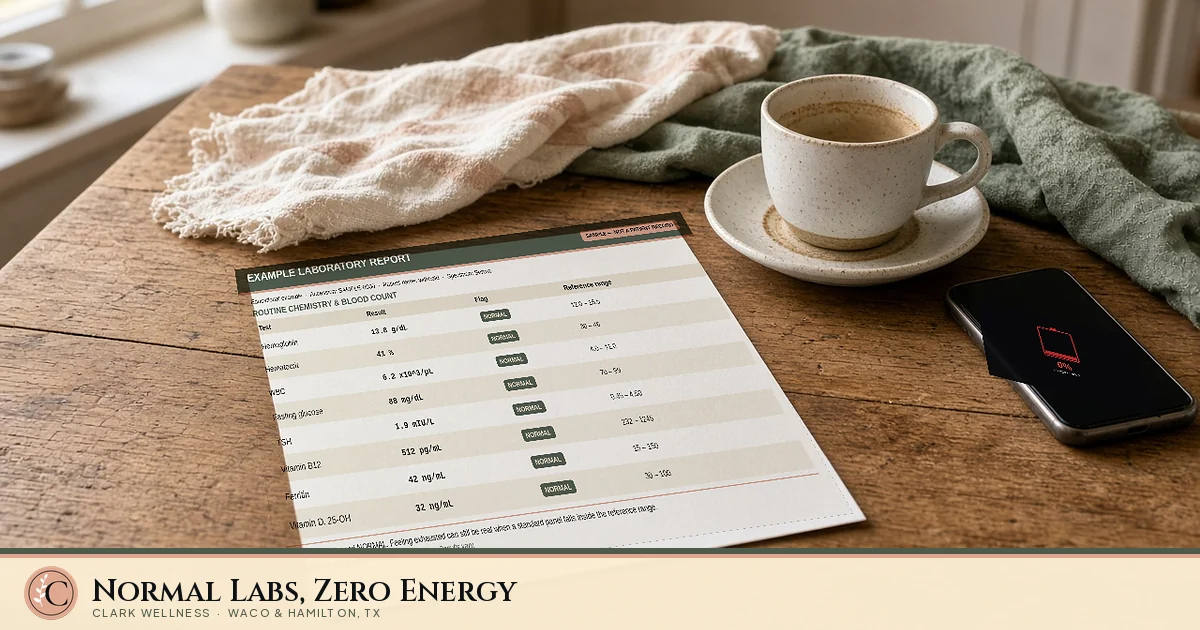
The short answer: Yes, your labs can read "normal" and you can still feel wiped out. A normal result usually means your number falls inside a statistical range built to flag disease, not that your body is working at its best. Functional medicine looks at whether those numbers are optimal for you, and at the systems a short panel can miss.
Key takeaways
- •"Normal" on a lab report typically means the middle 95% of a reference group, so about 1 in 20 people land outside it on any single test.
- •Optimal is a different question: where in the range you sit, and how you actually feel.
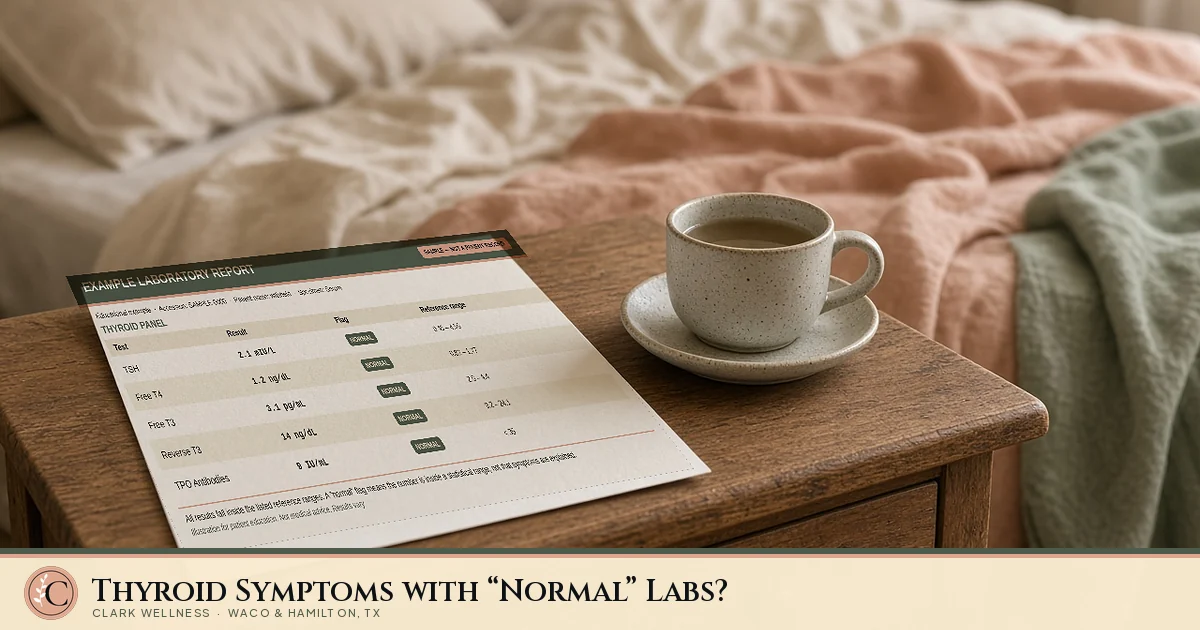
- •A TSH-only thyroid screen can't speak for free T3, free T4, or thyroid antibodies.
- •Fatigue often has a root-cause pattern: sleep, iron, a full thyroid view, blood sugar, B12 and vitamin D, cortisol rhythm, and perimenopause, which can start in the late 30s and 40s.
- •The smartest next step is a clearer map and a longer conversation, not a bigger supplement shelf.
What does "normal" actually mean on a lab report?
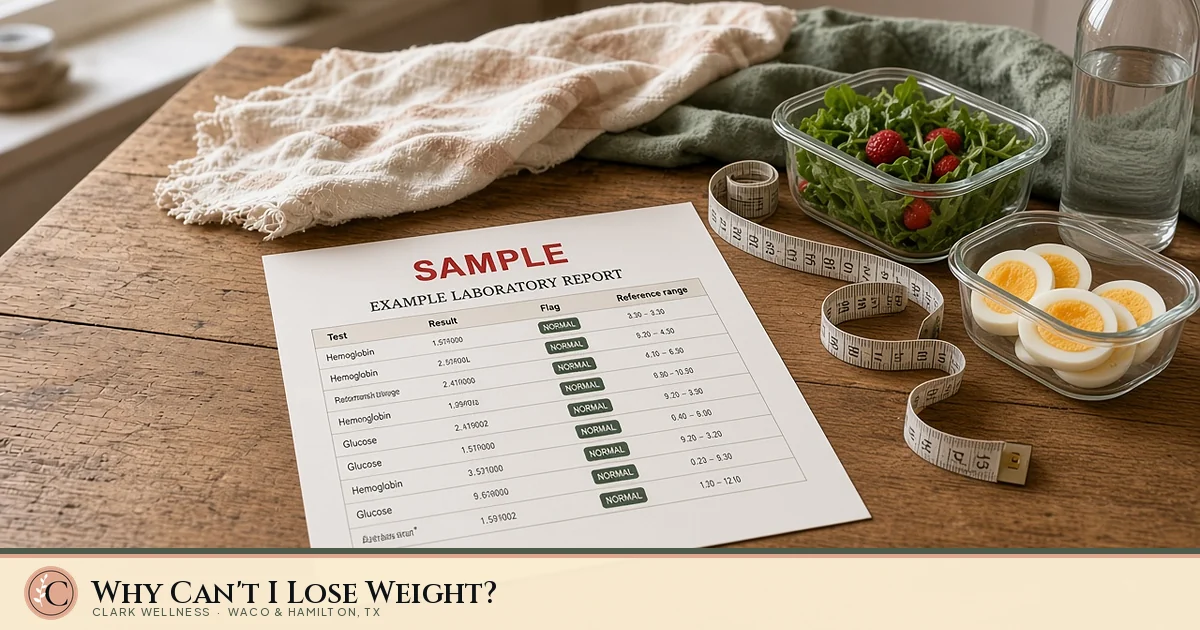
A lab's reference range is typically built from the middle 95% of results in a defined group of people considered healthy. That leaves out the lowest 2.5% and the highest 2.5%, which means roughly 1 in 20 people will land outside the range on any one test. It's a statistical convention designed to flag disease. It is not a verdict on how well you function.
Think of it like a dress code: "business casual" covers a lot of outfits. A result inside the range tells you you're within the guardrails, not whether you're in an optimal part of the lane or how you feel while driving.
Why are so many of us asking AI about this?
Because it's 11 PM and no office is open. Microsoft AI found that about 10.9% of Copilot health questions were about interpreting symptoms or lab and imaging results. A separate analysis found that 10.2% of ChatGPT conversations are mainly about health, and women's chats skew higher (11.8% versus 6.5% for men).
Using AI to organize your questions is smart. Just remember it can't examine you or know what was, and wasn't, on your lab order.
What can make you tired when your labs look fine?
Fatigue is a signal, not a character flaw, and it usually has a root-cause pattern rather than a single villain. Short sleep is a big one: CDC data show about 39% of adults ages 45 to 64 get less than 7 hours. A more complete map often includes iron status, a full thyroid view (not TSH alone), blood sugar patterns, vitamin B12 and vitamin D (test so you know your numbers), your cortisol rhythm, and the hormone shifts of perimenopause, which The Menopause Society notes usually begin in the mid-40s and can start in the 30s.
The Institute for Functional Medicine describes this as a systems-biology approach: you and your clinician look for underlying contributors and build a personalized plan. That list is a starting map, not a self-diagnosis checklist.
What should I do next?
Start simple and stay curious:
- 1Write a two-week timeline. Note energy, sleep, meals, and anything that changes the pattern.
- 2Get the full lab report, not just the summary, and ask what was tested. If thyroid was checked, ask whether that included free T4, free T3, and antibodies, or TSH alone.
- 3Ask what else could be contributing. "What would you want to look at next?" is a friendly, useful question.
- 4Protect the basics for two weeks: a steady sleep window, protein at breakfast, daylight, and a short walk.
- 5Get prompt care for red flags such as chest pain, fainting, shortness of breath, unexplained weight loss, or severe mood changes.
A standard workup is designed to catch conditions that need treatment, and that matters. Functional medicine asks a complementary question: what may be contributing, even when no disease label fits yet?
Want to dig into this with me? I'm teaching a free live class, The Hormone Hoax: Why Your Labs Look Normal but You Still Feel Off, on Tuesday, Nov 17, 6–7 PM Central on Google Meet. Seats are free, and the link goes only to registered attendees. Claim My Free Seat.
Quick FAQ
Can I be tired with normal thyroid labs?
Yes. A thyroid screen may measure just TSH. A more comprehensive view includes free T4, free T3, and thyroid antibodies, plus how you feel, because a number inside the reference range is not the same as an optimal pattern.
Does a normal result mean the lab is wrong?
No. The result is probably accurate. It simply means the value falls inside a range designed to flag disease, not to describe whether your body is working at its best.
When should I get checked right away?
If fatigue comes with chest pain, fainting, trouble breathing, unexplained weight loss, or severe mood changes, seek prompt medical care rather than waiting.
Sources
- •PubMed: Defining laboratory reference values and decision limits
- •JABFM: Interpreting Normal Values and Reference Ranges for Laboratory Tests
- •Microsoft AI: How People Use Copilot for Health
- •State of the Prompt: What Americans Ask ChatGPT About Health
- •CDC FastStats: Sleep in Adults
- •The Institute for Functional Medicine: What Is Functional Medicine?
- •The Menopause Society: Many Women Still Confused About Perimenopause
- •The Menopause Society: International Differences Exist in Knowledge Gaps and Most Common Perimenopause Symptoms
Not medical advice. Results vary.
Want to talk this through?
Book a free discovery call with Angelica Clark, PA-C, FMCP-M, or take the free Root Cause quiz to get a clearer picture of what may be driving how you feel.