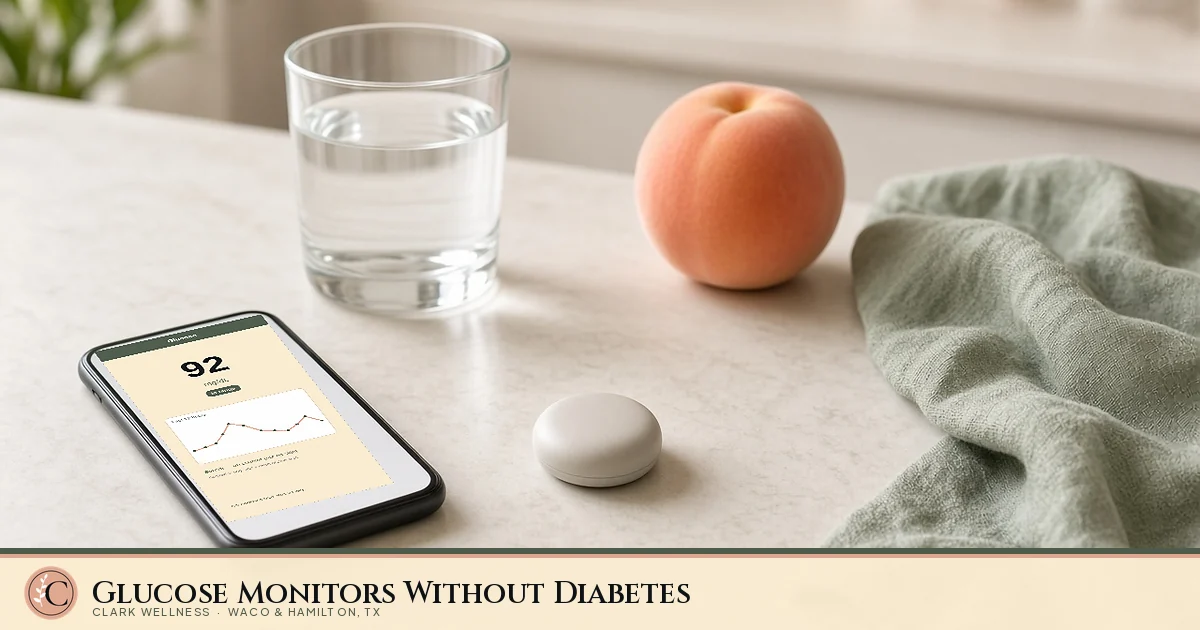
The short answer: Yes, a continuous glucose monitor (CGM) can be a useful personalized feedback tool even if you don't have diabetes. It shows the movie of your blood sugar, not just a single snapshot, so you can see how a breakfast, a rushed lunch, a short night, or a walk actually lands for you. Use it to learn your patterns, then pair that insight with a steadier plate and movement.
Key takeaways
- •A CGM shows your personal glucose pattern in real time: how high you go after a meal, how quickly you come back down, and how you feel along the way.
- •Post-meal rises happen for everyone. In a study of 153 healthy, nondiabetic participants, the median time between 70 and 140 mg/dL was 96%, with brief rises after meals.
- •Stress, skipped meals, inactivity, and hormonal changes can also move blood sugar, which is why the same lunch can land differently on two different days.
- •Build your plate on protein, vegetables, and fiber, and take a short walk after meals to support a steadier pattern.
- •A fasting glucose or A1c is still a helpful snapshot; a CGM fills in what happens between those lab draws.
Do I need a glucose monitor if I don't have diabetes?
You might find one genuinely useful. Since the FDA approved over-the-counter versions, more people without diabetes can see their own glucose pattern. A single fasting lab is a still photo. A CGM is a time-lapse of how your body handles food, stress, sleep, and movement.
Functional medicine is personalized by design. Seeing your own curve helps you and your clinician connect afternoon crashes, cravings, or foggy stretches to something you can actually work with.
Is a blood sugar spike after eating normal?
A rise after carbohydrate-containing foods such as fruit, milk, beans, and bread is expected, and stress, skipped meals, inactivity, and hormonal changes can move glucose too. In a multicenter study of 153 healthy, nondiabetic, non-obese participants who wore sensors for up to 10 days, the median time spent between 70 and 140 mg/dL was 96%, with brief rises above that after meals.
The useful question is not "Did it move?" but "What is my pattern, and how do I feel?" A sharp spike and a fast drop can contribute to fatigue and brain fog in the short term. A CGM lets you see which breakfasts stay steadier for you, and which ones send you hunting for a snack at 3 PM.
How do I use a CGM as a feedback tool?
Wear it with a plan, not as a scoreboard. Note meals, movement, stress, and sleep for a week or two and look for repeatable patterns: the pasta lunch versus the protein-and-vegetable plate, the short walk versus sitting, the late night versus a full one. Many people learn what they need in a short run of wears and can then practice those habits without watching every wiggle.
A CGM measures glucose, so it belongs in a broader picture, not in place of one. If a reading feels alarming or you have symptoms such as extreme thirst, frequent urination, or unexplained weight loss, check in with a clinician.
What habits make the most of what you learn?
Let the data point you toward things you can repeat:
- •Build your plate on protein, vegetables, and fiber, with fewer refined carbohydrates and added sugars, as the 2025–2030 Dietary Guidelines suggest.
- •Walk for a few minutes after meals. A 2022 meta-analysis found brief light walking breaks lowered post-meal glucose compared with sitting.
- •Protect your sleep, because blood sugar and energy are harder to steady when you're running short.
- •Ask about snapshot labs too. A fasting glucose and A1c remain a useful way to check in on longer-term patterns, and a CGM helps explain the days in between.
Blood sugar and insulin are a big part of my free live class, The Hormone Hoax, on Tuesday, Nov 17, 6–7 PM Central on Google Meet. It's free, and there's no sensor required. Claim My Free Seat.
Quick FAQ
What is a normal blood sugar after a meal?
Ranges vary by person and context. In one study of 153 healthy, nondiabetic adults and children, the median time between 70 and 140 mg/dL was 96%. A CGM helps you see your own pattern; ask your clinician how to interpret your numbers.
Are over-the-counter glucose monitors safe?
The FDA approved them for sale without a prescription. Use one as a learning tool, follow the device instructions, and talk with a clinician if readings or symptoms worry you.
Can blood sugar swings make me tired?
In the short term, spikes and dips can contribute to fatigue and brain fog. Persistent tiredness still deserves a proper evaluation, because thyroid, sleep, iron, and stress hormones can be part of the same picture.
Sources
- •Johns Hopkins Bloomberg School of Public Health: Are Glucose Monitors Useful for People Who Don't Have Diabetes? (Jan 28, 2026)
- •Continuous Glucose Monitoring Profiles in Healthy Nondiabetic Participants (PMC)
- •Sports Medicine 2022 meta-analysis: interrupting sitting with standing and light walking (Buffey et al.)
- •USDA: Dietary Guidelines for Americans 2025-2030 release (Jan 7, 2026)
- •The Institute for Functional Medicine: What Is Functional Medicine?
Not medical advice. Results vary.
Want to talk this through?
Book a free discovery call with Angelica Clark, PA-C, FMCP-M, or take the free Root Cause quiz to get a clearer picture of what may be driving how you feel.